
Lucy Stein
Lunula
Temple Bar Gallery + Studios, Dublin, IE
13 March - 3 May 2026
Lucy Stein’s expressive, emotionally and psychologically charged paintings result from what the artist describes as a ‘cosmic symbolic feminist headspace’. Her work has a deep connection to the principles and imagery of goddess culture (1) and mystical esotericism stemming from her studies in psychoanalysis and feminist theory. Iconography from classical mythology, medieval and ecclesiastical illuminations, as well as ancient rites and folkloric illustrations interact on her paintings’ amorphous surfaces. Despite these associations to archaic and arcane subjects, Stein’s stylistic references are rooted in Western European art history. Her paintings reclaim macho approaches to the medium from German Neo-expressionism and the Spanish Golden Age, simultaneously joining a lineage of female surrealists such as Ithell Colquhoun, Dorothea Tanning, and the more domestically-oriented works by Carole Gibbons. Stein also draws references from libraries and archives, including London’s Warburg Institute, which provides an expansive array of West Asian spiritual and allegorical imagery. Stein’s own performance art, that she made alongside her paintings for fifteen years, resulted in a DIY punk/riot grrrl aesthetic and attitude that pulsated with raw energy (2). Anthropologist and folklorist Amy Hale connects the cultural significance of Stein’s wide-ranging references with an eternal feminine sensibility: “Here we tell stories of women who wander, of women encountering the land, creating new narratives of wonder, curiosity, challenge.” (3)
Connecting the time she spent living in the west of Ireland around fifteen years ago, with her more recent years working within the rich folklore of St. Just in rural Cornwall, Stein channels the inherent energies of the natural landscape that have inspired and been worshipped over millennia. Looping through the psychic currents of Celtic imagination in the Burren and Cornwall, Stein brings to the surface a magical epiphany that she accesses through the practice of painting. While reflecting these enduring ancient reference points, Stein also responds to her personal experiences as a mother and caregiver. Her interpretations of female archetypes respond to centuries of belief and representation in connection to fertility and the power of nature’s capacity to renew. Her paintings are a determined resistance to contemporary obsessions with oversaturated visual culture, and the looming probability of ecological and political collapse on a global scale. Stein’s encyclopaedic clash of source material proposes an eco-feminist approach to painting in which symbols are open and dreamlike, developing organically through fluid interpretation: Endless layers of visual space are unified and obscured simultaneously; psychological portraits of the deep self connect through universal experiences of brutality and tenderness; dense mythological iconography intertwines with the blissful boundlessness of metaphysical landscapes. Stein’s visionary foresight creates numinous atmospheres that fuse psychological, spiritual and corporeal realms.
The symbol of the lunula recurs throughout the exhibition, referencing the gold, crescent moon-shaped ritual objects representative of lifespan and universality in Celtic and Atlantean cultures. It is also the name given to the light-coloured marks at the base of human fingernails that can present otherwise hidden health diagnoses. The number, scale, detailed patterning, and rich materiality of lunulae excavated from Bronze Age burial sites demonstrate their cultural importance, yet their exact significance is unknown. These ornamental necklaces may represent the lunar cycle and the connective celestial significance of the moon. The Romans gave their children lunulae to ward off spirits until they reached puberty, at which point the amulets were buried. The shape may also signify a coracle that carried the sun over the horizon in Atlantean beliefs, or delivered souls to the afterlife in classical cultures. With this symbolism Stein embraces these open narratives and iterations through cosmic space, the daily, bodily world and its cycles, and the tangible earth.
During the days preceding the exhibition, Stein made the painting Thin Places on a large, lightweight curtain, referencing Kerri ní Dochartaigh’s book about the healing power of nature (4). Stein’s permeable painted tableau assembles a series of discrete images from illuminated manuscripts: a pomegranate tree losing its fruit, an oak branch sprouting from a forest goddess’ torso, an elegant horse communing with a golden bird, and an oversized earthworm. The curtain is hung near the gallery windows creating a porous surface in which the reality of the world outside continuously merges and dissolves with the fragmented mythical imagery on the curtain’s lustrous fabric. The curtain also serves to create a sanctuary, or interior world within the gallery. The enclosed space resonates with the imagery and ideas of the selva oscura (5), a perilous journey to the unknown through moral darkness and psychological weight. The symbolic forest clearing, while functioning as a sacred place of respite, is also sited in the wilderness and comes with its own intensity, perhaps recalling the solemnity of a passage tomb or other hallowed ground.
As part of a project in The Museum of Witchcraft and Magic in Boscastle, Stein describes her artistic responsibility: “More and more I think that the sacred duty of the artist is to activate atmosphere and magic where possible. Getting people together in places that feel potent and doing things in those places that generate more power makes me feel healthy and alive.” (6)
While a constructed space in a gallery can obscure or negate the powerful flow of natural energy, the artworks within can be conductors of such power between people. Lunula invites deeper reading of the unconscious, and suggests pathways for self-recognition and reflection in a site of radiating expression.
(1) Goddess culture references the worship of ancient female deities and the modern revival of the divine feminine in nature, fertility, power, and wisdom. In classical terms Brigid, Aphrodite, Athena, and Gaia represent examples of the sacred feminine. In contemporary goddess culture, patriarchal values are challenged by reclaiming and re-imagining ancient goddess archetypes to embody the divine feminine. Catalan soprano Montserrat Figueras’ Lux Feminae 900 - 1600 (2006) is an album of early classical music, written as an invocation of feminist spirituality, an approach more recently adopted by Rosalía in a contemporary context for her album LUX (2025).
(2) From 2014-2017, Lucy Stein collaborated with Simon Bayliss on NTS radio programme, Squirming the Worm, which is archived and can be listened to here.
(3) From Fountains of Hecate, an essay by Amy Hale on the occasion of Lucy Stein’s exhibition ‘Wet Room’, at Spike Island, 2021. Read here.
(4) Kerri ní Dochertaigh’s Thin Places was published by Canongate Books in 2021.
(5) selva osurca, meaning ‘dark forest’ or ‘deep dark woods’ is a metaphorical place commonly used as a storytelling device from Dante’s Inferno to children’s fairy tales.
(6) Lucy Stein’s Banishment workshop took place at Boscastle Museum of Witchcraft and Magic, 18th May 2017, commissioned by Groundwork, Cornwall. Read Lucy’s document of the day here.
Lucy Stein’s recent solo exhibitions include Galerie Gregor Staiger, Milan and Zurich (2011–2026); Museo Casa Rusca, Locarno (2024); Hales Gallery, London (2023); De La Warr Pavilion, Bexhill-on-Sea (2022); Spike Island, Bristol (2021); Palette Terre, Paris (2018). Her work has been exhibited at Kunsthaus Zurich; Tate St Ives; TULCA Festival of Visual Arts, Galway.
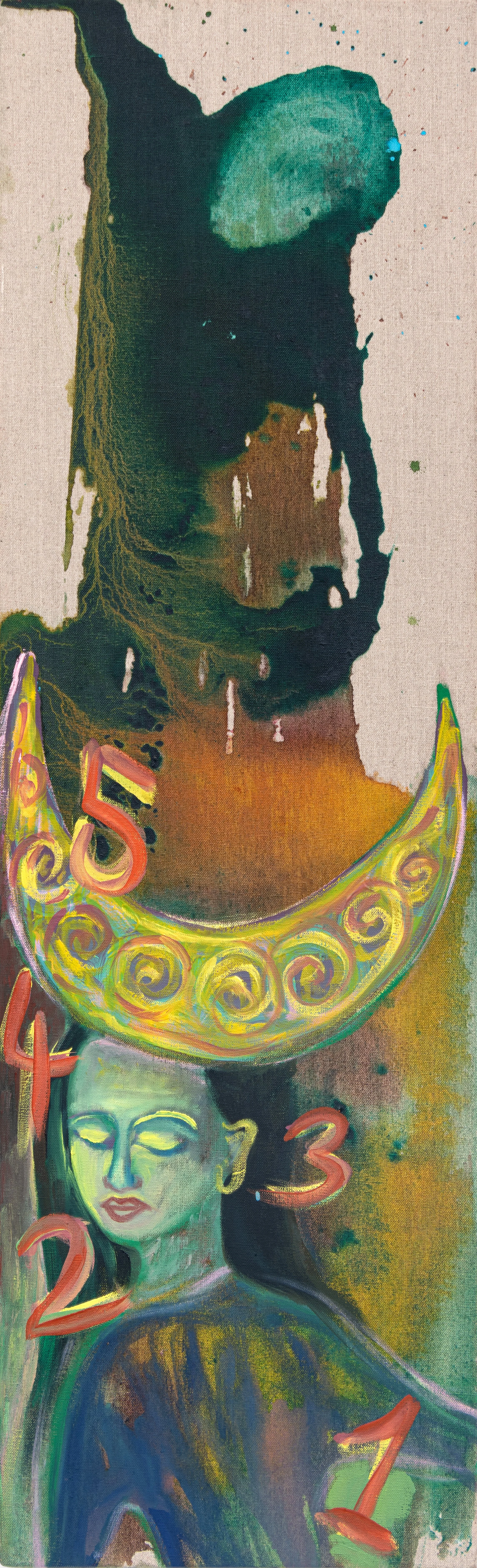
Lucy Stein, Lux Feminae, 2025. Oil and ink on linen, 92 x 28 cm. Courtesy of the artist and Galerie Gregor Staiger, Zurich/Milan.